
filtration

Email Address

sales@filtercartridgetech.com

Phone Number

(+86) 15057941949

Our Location

Zhejiang, China

Understanding Filter Efficiency: What Does Beta Ratio Mean?

1. Introduction – What is Filter Efficiency?

In the filtration industry, understanding filter efficiency is crucial for ensuring the purity of liquids and gases in industrial applications. Whether in water treatment, pharmaceuticals, chemicals, or food and beverage, selecting the right filter can prevent equipment damage, contamination, and costly downtime.

One key measure of filter performance is the Beta Ratio (β). Many engineers and buyers see β mentioned in filter specifications but don’t fully understand what it means. This article will explain Beta Ratio, how it relates to filter efficiency, and why it is vital for selecting the right filter cartridge.
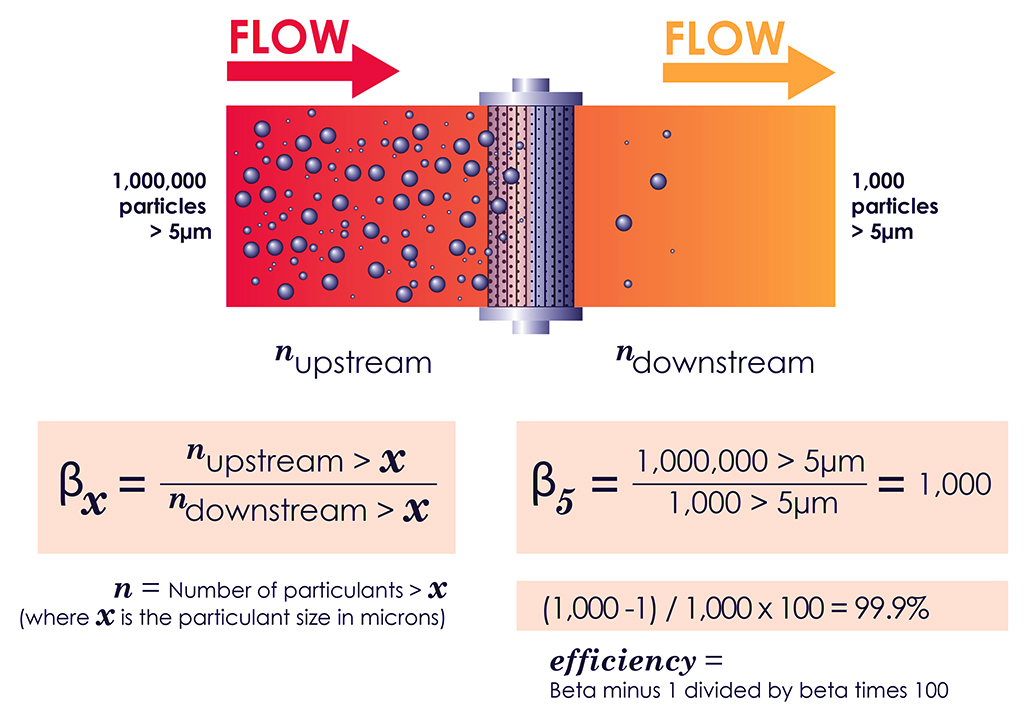
filter efficiency beta ratio

2. What is Beta Ratio?

The Beta Ratio (β) is a standard metric used to quantify a filter’s ability to remove particles of a specific size from a fluid.

Definition:

β=Number of particles upstreamNumber of particles downstream\beta = \frac{\text{Number of particles upstream}}{\text{Number of particles downstream}}

Example:
If a fluid has 10,000 particles of 5 microns per liter before filtration and 50 particles per liter after passing through the filter, the Beta Ratio is:

β=10,000÷50=200\beta = 10,000 ÷ 50 = 200

This means the filter removes 99.5% of 5-micron particles. Higher β values indicate better filtration efficiency for the specified particle size.

Types of Filter Cartridges We Offer

Different filtration requirements call for different filter cartridge designs. The three most commonly used cartridge technologies in water treatment systems are depth filter cartridges, pleated filter cartridges, and high flow filter cartridges.

3. Understanding Filter Efficiency Ratings

Filters are commonly rated as either:

  1. Nominal Rating – Filters remove a certain percentage (usually 85–95%) of particles of a specific size.
  2. Absolute Rating – Filters remove nearly all particles (typically 99.9%) of a specific size.

Beta Ratio vs. Nominal/Absolute Ratings:

  • Beta Ratio provides a precise numerical value of filtration efficiency.
  • It is more reliable for industrial applications because it quantifies how many particles pass through, rather than just giving a percentage.

Effect of Filter Material:

  • PP (Polypropylene) – Good for general water filtration, medium chemical compatibility, cost-effective.
  • PES (Polyethersulfone) – Excellent for biopharma and food-grade filtration, higher flow rate, low protein binding.
  • PTFE (Polytetrafluoroethylene) – Superior chemical resistance, high temperature tolerance, ideal for aggressive solvents.

Different materials will have different β values for the same micron rating, making Beta Ratio a key factor in filter selection.


4. How Beta Ratio Impacts Filtration Performance

Industrial applications rely on accurate Beta Ratio information:

  • Water Treatment: High β filters prevent clogging of downstream equipment and ensure clean water.
  • Pharmaceuticals & Biopharma: High β membranes minimize contamination, ensuring compliance with strict regulations.
  • Chemical & Petrochemical: Correct β selection prevents system corrosion and product contamination.
  • Food & Beverage: Efficient particle removal ensures product clarity and safety.

In short, higher Beta Ratio filters usually provide better particle retention but may have higher initial pressure drop. Engineers must balance efficiency, flow rate, and system requirements.


5. How to Measure Beta Ratio

Beta Ratio is measured according to ISO 16889:2018 standards:

  1. A known particle-laden fluid is passed through the filter.
  2. Particle counts are measured upstream (before filter) and downstream (after filter).
  3. Beta Ratio is calculated using the formula mentioned above.

Key Notes:

  • Beta Ratio is particle size specific. A filter may have a β of 200 at 5 microns but only 50 at 1 micron.
  • Testing conditions (flow rate, pressure, temperature) affect the results.

6. Choosing the Right Filter Based on Beta Ratio

When selecting filters, consider:

  • Application requirements: Critical processes (pharma, biotech) may require β > 200 for key particle sizes.
  • Flow rate & system pressure: High β filters can increase pressure drop.
  • Material compatibility: Choose PP, PES, or PTFE based on chemical and temperature conditions.
  • Cost vs performance: High β filters are more expensive; choose what the system truly needs.

Practical Tip: Always confirm β value from the manufacturer and ask for test conditions to ensure accurate comparison.


7. Common Misconceptions About Beta Ratio

  • “Higher β means longer filter life.” – Not necessarily; life depends on contamination load and flow rate.
  • “Absolute vs Nominal rating is the same.” – They differ; β provides a more quantitative measure.
  • “All β ratios are comparable.” – Only compare filters tested under the same conditions and particle sizes.

8. Practical Tips for Engineers and Buyers

  • Always verify Beta Ratio and particle size before ordering filters.
  • Keep records of filter performance vs system requirements to optimize replacement intervals.
  • Use filter charts showing β ratio vs efficiency for better decision-making.
  • Consider material selection: PP for general water, PES for biotech/pharma, PTFE for harsh chemicals.

9. Conclusion

Understanding Beta Ratio is critical for achieving the desired filter efficiency in any application. By comparing PP, PES, and PTFE filters with their β values, engineers and buyers can make informed decisions to ensure system performance, reduce downtime, and save costs.

Remember: Always combine β ratio, filter material, flow rate, and application requirements for optimal filtration performance.

滚动至顶部